
(Providence, Rhode Island)
An American political pioneer died today, and her life and her passing are significant. But a lot of commentators will probably get it wrong by calling her things like a “political legend” or “a historic lawmaker” (she was neither). The hyperbole of all the cable news network analysis often gets in the way of reality.
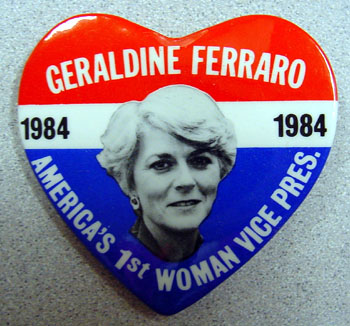
What Geraldine Ferraro was, was a trailblazer, an icebreaker, a standard bearer and a role model for women on both sides of the political aisle. Ferraro was not a political legend or a historic lawmaker; there is no long trail of significant legislation bearing her name. Nor is she a legend for her gender in the House of Representatives, because, by the time she arrived, a fair number of women had already served there.
Ferraro was really significant in bringing a new mindset to American voters - an acceptance that a woman could actually be qualified for and elected to the top job in the land. When I was traveling the country, covering the 2008 presidential campaign, someone at a rally said to me: “Hillary Clinton would not be here if it wasn’t for her husband.” Nonsense! Hillary Clinton got within a hair’s breadth of the Democratic nomination far more because of Geraldine Ferraro than because of Bill Clinton. The fact that three of the past four Secretaries of State were women (including Hillary), has a lot to do with Geraldine Ferraro, too.
Why is this? Because political movements in America go from the bottom up, not from the top down. Women started by getting elected to school boards, city councils and even state legislatures in the 1960s and 70s. Then some moved up to the House and Senate in Washington. Some, such as Rep. Shirley Chisholm (D-NY) and Rep. Patsy Mink (D-HI), even dared to run for President, though few took them seriously.
But by 1984, things had really changed in the American political landscape. People such as Ella Grasso (D-CT) and Dixie Lee Ray (D-WA) had been elected governors, and Diane Feinstein was a gutsy, big-city mayor. Justice Sandra Day O’Connor was well into her pioneering years on the U.S. Supreme Court. In many places voters weren’t just electing women to “back bencher” roles in small governmental bodies; they were actually putting them in charge of running the show! And even male Presidents were nominating them for cabinet positions or the high court.
Despite all of this, could a woman be President? The answer is a resounding "yes," even though it has yet to happen. In a sense, what Geraldine Ferraro “won” greatly overshadows the fact that her ticket lost the election. What she “won” was the nomination of her party and the consideration of all voters on Election Day. That’s huge!
Fast forward to 2008, and I found Ferraro’s commentary profound when Sarah Palin was nominated by Republicans to be Vice President. Ferraro, despite a huge ideological difference, was one of Palin’s biggest defenders. Why? Because she had been there and experienced some of the very same treatment, both good and bad. Here is what Ferraro said of the Palin nomination in one interview:
“It’s going to be a very interesting campaign. I must say that several months ago I said that it would be great if there was a woman on the ticket, that I felt that John McCain would have to pick someone, especially if Hillary was the nominee; but without Hillary being the nominee it’s really quite equally as important, because people are looking for a historic campaign, and I think this might do it. There are a lot of women who are disaffected by how Hillary was treated by the media, by how she was treated by the Obama campaign, by how she was treated by the Democratic National Committee, Howard Dean not speaking up when sexism raised its ugly head in the media,” Ferraro said.
Both women endured some of the same sexist coverage, with commentary about hair styles, outfits and whether their family obligations were more pressing-- treatment male candidates rarely, if ever, endure. Both underwent significant scrutiny of their spouses and children, again something male candidates rarely encounter. And both were blamed by some pundits and partisans for the loss of their presidential tickets. In neither case was that true. Walter Mondale and John McCain both lost- in large part- due to the overwhelming popularity and likability of an opposing candidate who was a far better communicator. They didn’t lose because they chose a woman for Vice President.
So Sarah Palin owes a great debt to Geraldine Ferraro. So, too, does Hillary Clinton. And the same will be said of other women who seek the highest offices in the land. Today there are 6 female governors; 4 Democrats and 2 Republicans. There are 17 female U.S. Senators—the highest number ever—12 Democrats and 5 Republicans. Ferraro’s impact on the opportunities for women in both parties is significant. She broke new ground.
It will be historic when a woman finally sits in the oval office, and it will happen. But the pioneering significance will be traced back to 1984, when millions of American voters were finally confronted with the question: "Would you be willing to put a woman in the White House?" and the answer for millions of voters was “Yes!”
(Mark Curtis’s political reporting can be seen on WLNE-TV ABC6 in Providence, RI, and he appears frequently as a political analyst on KGO Radio and KGO-TV ABC 7 in San Francisco).
 Delicious
 Digg
 StumbleUpon
 Facebook
 Google
 Yahoo
Post new comment