
(Providence, Rhode Island) – People often ask me, “Where do you get the ideas for your weekly political blog?” Sometimes – such as last week, when two Presidential candidates entered the race – it’s easy. Then there are the proverbial “slow news days,” when finding an interesting nugget is difficult. Let’s “brunch” on that this week!
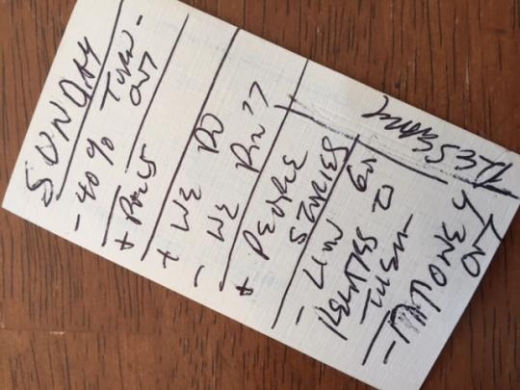
“What Are People Talking About?” - I was at a birthday party Saturday night, and everyone there was a political junkie. I jotted down a number of items from our conversations on the back of a business card, and today’s column was born. Sometimes it’s as simple as engaging people about what they have shared with you. I know my notes look like a jumbled mess, but they are “prompts” for each of the observations I make here today.
“Not Everyone’s Cup of Tea!” – Over the years, I have discovered three groups: Those junkies, like me, who love politics; the people who absolutely hate politics and run from the discussion like scalded dogs; and those who drop in and drop out of the political conversation, usually entering the arena about four to six months before a campaign, and vanishing from the discussion by Inauguration Day.
“What’s a Reporter to Do?” – Given the divergent public sentiment towards politics, it’s often challenging what to cover, or what not to cover. Media management really struggles with this, reaching little consensus. On a recent job interview, the prospective boss told me, “We want you covering politics 24/7, and that’s all we want you to do!” A week later, a news manager at a different TV station said to me, “Unless the Mayor gets caught with a prostitute, we just aren’t interested in covering politics!” Those are two vastly different business models, but why the difference?
“The Audience Is Boss” – A lot is determined by making an educated guess about what the public wants, sometimes at the expense of sacrificing what the public needs to know about. News content is heavily researched at many media outlets, and the results are stark. Do you know why you see so many health stories on the news? That’s because audience-member surveys tell news managers that’s what viewers want. Do you know why you see so little international news anymore? Because a lot of viewers say it’s boring, not important, or not relevant to their lives (even though it may be).
“The 40-Percent Solution” – This past midterm election in 2014 brought just 36.4 percent of voters to the polls nationwide. That’s the lowest turnout since World War II. Obviously, a lot of people are disconnected, or are uninterested in the political process. Consequently, you get news executives who say, “Why should we cover politics, when only about one-third of the audience is interested?” My answer is always that the public needs to know about what the politicians are doing, even though they may not want to know. (It’s like your parents' making you eat your vegetables as a kid. You may not want to eat them, but you need to eat them!) Sometimes I win the argument; sometimes I don’t.
“But Wait! People Are Interested!” – The audience sends us mixed signals; that’s a given. Whenever I do a public speaking event – most often during campaign seasons – people usually ask two questions: a) Who is winning?; and, b) For whom will you vote? The last question is easy. For reasons of personal privacy and professional ethics, I never disclose my voting choices publicly. Only my family knows. As to the first question, I find it curious that so many people – from the fully engaged, to those who are indifferent – all want to know who is ahead in the polls. It’s the “horserace” aspect of political campaigns that draws so much interest. I realize a lot of people watch politics like a sporting event, but at least they are trying to pay attention to some of it.
“We Can Do Better” – As an industry, the media can do a much better job of covering politics. All too often, a reporter goes to the State House and interviews politicians who are for or against a big tax increase. It’s all about the winners and losers, but that’s only half the story. Reporters need to get out and interview average working people who are directly affected by the votes cast by politicians. As I mentioned earlier, there is often a big disconnect between politics and the people, and part of that is because the press does not make the story relevant to the average viewer or reader. Something as simple as interviewing a small business owner about how a minimum wage hike would affect her business would be a good step in the right direction. The bottom line: Make politics relevant to people!
“The Disenchanted, the Disconnected, and the Disappointed” – Maybe more people would be interested in politics if the culture of politics changed. In my lifetime we’ve had the political disasters of Watergate in the 70s; impeachment in 1998; no WMDs in 2004; and Benghazi in 2012, plus many others. All scandals – from both sides of the aisle – do nothing but erode public interest and confidence in the process. No wonder people tune out and so few show up to vote.
What do you think? How would you like to see politics covered for the better? Just click the comment button at www.MarkCurtisMedia.com.
© 2015 Mark Curtis Media, LLC.
Photo courtesy: MCM
 Delicious
 Digg
 StumbleUpon
 Facebook
 Google
 Yahoo
Post new comment