
(Charleston, West Virginia) – I was a big follower of the civil rights movement in the 1960s, and remember well the life and death of Dr. Martin Luther King, Jr. I also remember the group of lieutenants who surrounded him and how many of them became prominent after his death. It made me wonder, “Where are they now?” Let’s brunch on that this Martin Luther King Holiday weekend:
“The Successor” – The Reverend Ralph Abernathy was the closest associate of Martin Luther King, Jr., and became head of the Southern Christian Leadership Conference (SCLC) upon King’s death. Abernathy was certainly not as fiery an orator as King (Who was?), but he led some successful protests and even helped negotiate an end to the infamous standoff between Native Americans and FBI agents at Wounded Knee, South Dakota. Abernathy died in 1990 at the age of 64. I was in Atlanta, covering another story, the day of his funeral, and remember a city in deep, deep grief.
“Like Father; Like Son” – Many people forget that King’s father, the Reverend Martin Luther King, Sr., was a noted civil rights leader in his own right. Both had been baptized "Michael King," but the father decided to change their names in honor of Protestant reformer Martin Luther. In 1931, the senior King became pastor of Atlanta's famed Ebenezer Baptist Church, which later became ground-zero for the civil rights movement. King suffered several tragedies, including his son Martin’s assassination. His other son died the very next year; and his wife, Alberta, was murdered during services at Ebenezer in 1974. King, Sr., died in 1984 at the age of 84.
“King’s Dream Embodied” – If one person in the whole civil rights brigade embodied what Dr. King wanted, it was the Reverend Andrew Young. Like many of the others noted here, Young was an influential member of the SCLC. He was later elected to Congress; became U.S. Ambassador to the United Nations; and then served as Mayor of Atlanta for eight years before entering the corporate world. When I worked for Cox Communications, Young was on its board of directors. His career was not without controversy, as his close ally - President Jimmy Carter - asked Young to resign from the United Nations over a controversy with Israel. Nonetheless, Young was a huge success in politics and private business. Today he is 83.
“The Soul” – If Martin Luther King, Jr., was the heart of the civil rights movement, John Lewis was the soul, in my opinion. Lewis was in his twenties in the 1960’s, half the age of many other leaders in the movement. He headed the Student Nonviolent Coordinating Committee (SNCC). He also helped lead the Freedom Summer voter registration drives and the famed marches from Selma to Montgomery (one of which resulted in his being severely beaten by police.) Lewis was later elected to Congress, where he will complete his thirtieth year in 2017. I interviewed him many times when I was the Washington, DC, correspondent for WBS-TV2 in Atlanta. He shared a lot of stories from the civil right movement with me. I always considered him a “walking history book.”
“The Successor II” – The Reverend Joseph Lowery became the third leader of the SCLC after Ralph Abernathy retired in 1977. Lowery was far more confrontational and controversial than King or Abernathy, saying such things as, “All white folks are going to hell.” I’ve interviewed him a number of times. Once, when he was coming to give a speech in Pensacola, Florida, where I was a reporter, his aide called and asked me to attend. I said, “I will try, but I can’t guarantee I’ll be there.” His aide said that if I did not guarantee my coverage “Rev. Lowery will call Coretta Scott King and have a formal complaint filed against you with the FCC.” In the end, another reporter covered the event – not because of the threat, but simply because it was newsworthy. Today, Lowery is 91.
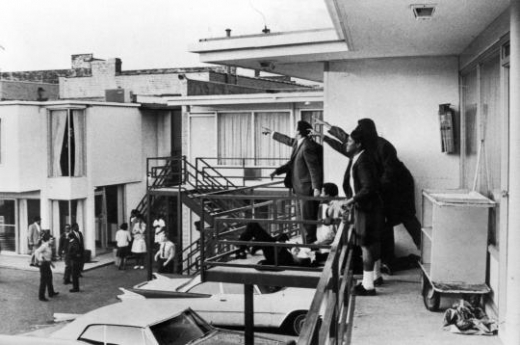
“The Post-King Star” – As prominent as these men have been, certainly no one grabbed the spotlight as much as the Reverend Jesse Jackson. He was the only one who came close to matching King’s oratory. He showed up at every crisis - including overseas – whether invited or not. But he kept the civil right movement on the front burner (and in the news), for over thirty years. Jackson – whom I’ve had the chance to interview several times - ran for President in 1984 and 1988. His time on the public stage lessened in recent years after some personal controversies, but he remains somewhat active politically. Jackson- who along with Ralph Abernathy and Andy Young, was with Dr. King when he was assassinated in Memphis (photo above) – is now 74 years old.
What are your memories of the civil rights movement? Please leave your comments by clicking the comment button at www.MarkCurtisMedia.com.
© 2016, Mark Curtis Media, LLC.
Photo courtesy: Time.com
 Delicious
 Digg
 StumbleUpon
 Facebook
 Google
 Yahoo
Before King, Malcolm X and Garvey, much of the origins of the African heritage civil rights movement originated in 18th century Rhode Island.
Post new comment