
(Providence, Rhode Island)
The buzz this week in media land is all about those wacky twin babies who were caught on camera conversing with each other. It was funny and the talk at water coolers everywhere. The video went around the world (or "viral," as they say) on You Tube. It was posted all over Facebook, and the word spread on Twitter. The next thing you know, the families were on the “Today Show,” “Good Morning America,” and every local newscast in America.
Wait a minute? Isn’t that backwards?
No, in the modern world of media and journalism-- in many respects-- the “New Media” is leading the old.
Rewind to the turmoil in Egypt, when the government shut down the media and turned off the Internet. News still got out via texts, Facebook and Twitter postings via cell phones. The people couldn’t be silenced!
Rewind three weeks to the earthquake and tsunami in Japan. I happened to be in California on Friday, March 11. I awoke to all kinds of turmoil. The first I knew of the tsunami was a text alert on my cell phone. Even though it was technically my day off, I sprang into action. Since the waves from the Japan quake were headed east, California was under a tsunami warning; and the first waves were predicted to hit at 8:30 local time.
I was racing to the waterfront. I called my newsroom and said, “I’m going to San Francisco Bay. I’ll do a Skype ‘live shot’ for the noon show from my laptop and record another report for later. I’ll also be posting on Facebook and Twitter, and I’ll email photos for ABC6.com.”
While there was not enough time to make it to the Pacific Ocean, I decided to head to the Berkeley Marina on the east side of San Francisco Bay. There is a big pier, well over a mile long, which juts out into the bay. It is directly across from the Golden Gate Bridge, which spans the opening into the Pacific Ocean. If we were going to see tsunami waves, they would enter the bay at that point.
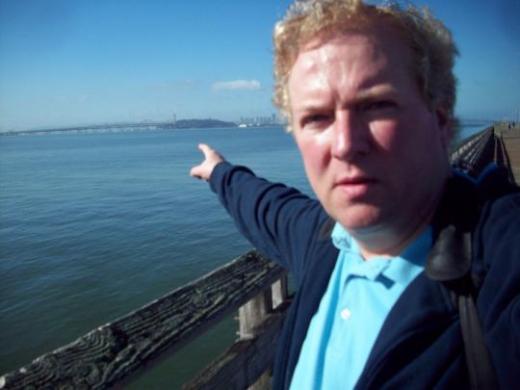
At 11:45 Eastern Time, I dialed master control at ABC-6 on Skype from my laptop computer. I was on battery power, transmitting on my Verizon Wireless Internet modem on my computer. There was no satellite dish, no microwave transmitter, and--for that matter--no TV crew. It was just me, talking into my Logitech Webcam, with a built-in microphone. On my video screen I could see me and Doreen Scanlon, my co-anchor at ABC-6 in Providence, Rhode Island. I held the laptop in my hand, as I turned and pointed to the bay waters and the opening under the bridge (photo above). No tsunami waves yet, but they would be coming.
After my broadcast I walked back to the shore. I dialed back into ABC-6 from my laptop and recorded a story for our 4 p.m. newscast. As I was getting ready to do that, two waves hit the shore in rapid succession. Prior to that, the water had been as flat and still as a piece of glass. The sudden waves were startling and loud, but were only about two feet high and did no damage.
The water quickly went back to calm and tranquil. The same cannot be said for the media world. Everything has changed, and everything keeps evolving. I was so glad that I “reinvented” myself in 2008 while working on the presidential campaign trail. I was no longer a reporter, tethered to a live-truck and dependent on a separate videographer and editor. I was what they were now calling a multi-media journalist, or MMJ. It is the future!
I was thinking about all of this on April Fools’ Day, April 1. It was also the 25th anniversary of the day I defended my thesis at the University of Florida and received my Master's Degree. In May it will be the 30th anniversary of my Bachelor's Degree in Broadcasting from Marquette University. The following words and phrases were not even in existence on those two occasions: Internet, Twitter, Skype, Facebook, You Tube, USB, MMJ, webcam, and wireless modem. And anything “viral” was something we ran from, instead of embracing.
It really is a “New Media” landscape and is still changing so fast. Honestly, some of the technology we are using today could be obsolete two years from now. So, as we still say on TV: “Stay tuned!”
(Mark Curtis is the morning co-anchor and chief political reporter on “Good Morning Providence” on WLNE-TV ABC 6 in Providence, Rhode Island. He also frequently appears doing political analysis (in person or via Skype) on KGO-TV ABC 7 and KGO Radio 810 AM in San Francisco).
 Delicious
 Digg
 StumbleUpon
 Facebook
 Google
 Yahoo
Nice piece, Mark, :) Very nice.
Mark, that's the Eastern span of the Bay Bridge you're point to. Expecting a wave from San Jose?
John: You are right, but this is something of an optical illusion. I was actually pointing to the gap under the Golden Gate while I am standing on the Berkeley Pier, but I am also the one holding the camera. Since my arm was fully extended-- but angled about 45 degrees to my body-- it actually appears that I am pointing elsewhere, since the camera is so close, and the intended target miles away. I wish there had been someone else there to take my photo, instead of me! The scene was surreal, especially when the wave came in!
Many thanks for writing and best wishes!
Mark
Post new comment